
3125 S 3rd Place Terre Haute, IN 47802 Phone 812-238-1047

Daniel Harrington

  • 1-2 Maccabees

    $19.95

    Often neglected, the books of the First and Second Maccabees are important for Christians, as in them is told how the Jewish people established the political and religious culture into which Jesus was born. The martyr stories inform the early Christian martyrdoms, and the books are written in Greek, the language in which the Jews of Jesus’ time read the scriptures. More importantly, as Father Harrington notes, without the Maccabees, “the fate of Judaism (and with it Christianity and Islam) was uncertain.”

    in stock within 3-5 days of online purchase
    Add to cart
  • Paul And Virtue Ethics

    $94.28

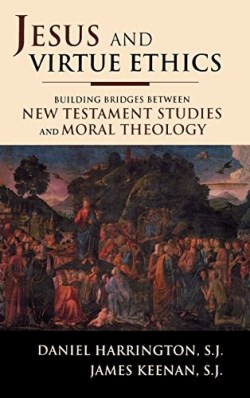
    In Paul and Virtue Ethics, Daniel Harrington and James Keenan build upon their successful collaboration Jesus and Virtue Ethics to discuss the apostle Paul’s teachings as a guide to interpret theology and ethics today. Examining Paul’s writings, the authors investigate what they teach about the basic questions of virtue ethics: Who am I?; Who do I want to become?; And how do I get there? Their intent is not to provide stringent rules, but to awaken discovery and encourage dialogue.

    The book first considers the concept of virtue ethics-an approach to ethics that emphasizes moral character-and Paul’s ethics in particular. Next, the authors focus on the virtues of faith, love/charity, and hope as treated by Paul and Thomas Aquinas. Closing the book with reflections on the roles of other virtues (and vices) in individual and communal Christian life, the authors discuss various issues in social ethics and sexual morality as they are dealt with in Paul and in Christian virtue ethics today.

    Special features:

    * highlights the practical relevance of Scripture today

    * a unique collaboration between a biblical scholar and a moral theologian

    * an accessible introduction and fresh approach to Pauline studies

    * an engaging and unique approach to virtue ethics

    in stock within 3-5 days of online purchase
    Add to cart
  • Hebrews

    $49.95

    Scarcely any book of the New Testament (with the possible exception of Revelation) is so perplexing as the “Letter to the Hebrews.” Not really a letter, but a sermon with some features of a letter added to it, not really by its putative author, Paul, but by an anonymous Christian who wrote some of the most elegant Greek in the Bible, not really addressed to the “Hebrews,” but to Christians, probably in Rome-this is the work that Alan Mitchell explains in this commentary.

    Many scholars have written fine commentaries on Hebrews, and Mitchell stands on their shoulders, noting where he proposes alternate interpretations. Mitchell pays particular attention to the reliance of the author of Hebrews on the Greek Old Testament (the Septuagint). He also compares the language of Hebrews with similar usage and ideas of first-century Hellenistic Jewish authors, notably Flavius Josephus and Philo of Alexandria. Furthermore, he situates Hebrews against the background of the tradition of Hellenistic Moral Philosophy, where that is appropriate. Mitchell thus locates Hebrews in its proper thought-world, something that is essential for the modern reader in dealing with some of the thornier questions raised by this biblical book. Chief among these are the role of sacrificial atonement, the question of “second repentance,” and the spiritual and moral formation of the Roman Christians who were its recipients.

    Like all the volumes in the Sacra Pagina series, this work examines the text in detail, with careful attention to the words and phrasing, and then brings those individual insights together into a coherent summary. The bibliography and special lists appended to each chapter cover the best of recent scholarship on the Letter to the Hebrews.

    in stock within 3-5 days of online purchase
    Add to cart
  • Pastorial Epistles : First Timothy Second Timothy And Titus

    $29.95

    First and Second Timothy and Titus have for many years borne the collective title “The Pastoral Epistles.” Both their style and their content make it difficult to locate them within the corpus of Pauline letters, and recent scholarship most often considers them pseudonymous, works that imitate Paul’s letters but apply the apostle’s teaching to the concerns of a later time, two or more decades after Paul’s death.

    The Pastorals differ from Paul’s own letters in being addressed to single individuals, coworkers of Paul who have been placed in charge of particular churches-Timothy apparently in Ephesus, Titus in Crete. They provide instruction for community leaders, both the individual addressees and other leaders whom they will appoint. The specification of certain offices within the local churches is one of the features that appear to locate these works in a later phase of church development.

    In this commentary Benjamin Fiore, SJ, places the Pastorals in their historical and literary context. The reader will find here a solid introduction to parallel literary forms in Latin and Greek literature and particular descriptions of the way in which these documents use ancient rhetorical forms to achieve their paraenetic and hortatory purpose. Drawing on his parish experience as well as his academic training, Fiore also provides reflections on the contemporary pastoral application of these books, giving readers a renewed appreciation for the “pastoral” label these epistles bear.

    in stock within 3-5 days of online purchase
    Add to cart
  • Philippians And Philemon

    $49.95

    Philippians is one of the most interesting and beloved of Paul’s undisputed epistles. In Philippians and Philemon, Bonnie Thurston makes a convincing case that canonical Philippians is as Paul wrote it, one letter. A translation conforming as closely as possible to the original Greek is provided, along with a careful analysis of the language of the letter that yields insights into the context and theological underpinning of this epistle.
    The apostle’s very brief letter to Philemon stands solidly within the Pauline collection of authentic and canonical letters. In this commentary Judith Ryan shows how Paul combined his theology with contemporary rhetorical strategies to produce an effective challenge to his audience.

    in stock within 3-5 days of online purchase

    Add to cart
  • 1 Peter Jude And 2nd Peter

    $39.95

    Crisis in the church is not a new phenomenon. In fact, the church has always been-and probably always will be-involved in some kind of crisis. Even in the apostolic period, which is regarded by many as the church’s golden age, there were serious crises coming both from the outside, as in 1 Peter, and from the inside, as in Jude and 2 Peter. The three short New Testament letters treated in 1 Peter, Jude and 2 Peter illustrate the problems early Christians faced as well as the rhetorical techniques and theological concepts with which they combated those problems.

    In the first part of this volume, Donald Senior views 1 Peter as written from Rome in Peter’s name to several churches in northern Asia Minor-present-day Turkey-in the latter part of the first century CE. The new Christians addressed in 1 Peter found themselves aliens and exiles in the wider Greco-Roman society and suffered a kind of social ostracism. But they are given a marvelous theological vision of who they have become through their baptism and pastoral encouragement to stand firm. They are shown how to take a missionary stance toward the outside world by giving the witness of a holy and blameless life to offset the slander and ignorance of the non-Christian majority and possibly even to lead them to glorify God on the day of judgment.

    In the second part of this volume, Daniel Harrington interprets Jude and 2 Peter as confronting crises in the late first century that were perpetrated by Christian teachers who are described polemically as intruders in Jude and as false teachers in 2 Peter. In confronting the crises within their churches, the authors appeal frequently to the Old Testament and to early summaries of Christian faith. While Jude uses other Jewish traditions, 2 Peter includes most of the text of Jude as well as many distinctively Greek terms and concepts. It is clear that for the authors, despite their different social settings, what was at stake was the struggle for the faith.

    in stock within 3-5 days of online purchase

    Add to cart
  • 1-3 John

    $44.95

    The Johannine Epistles are today read as an important part of the Johannine literature. Yet the meaning of the text is often unclear. Part of the problem arises because, although 1 John is called an Epistle, it lacks the formal marks of an Epistle. In 1, 2, and 3 John, John Painter illuminates the relationship 1, 2, and 3 John have to each other and to the Gospel.
    Painter explains the historical context of the Johannine Epistles using a socio-rhetorical approach. The writings are shown to reflect a situation of conflict and schism within the Johannine community; they seek to persuade the readers of the truth of the writer’s message. In this truth, the readers are encouraged to abide if they would have the assurance of eternal life.

    Painter also examines the inseparable connection between belief and ethical life in active love for one another. Through the socio-rhetorical approach Painter brings to light the continuing relevance of these writings.

    in stock within 3-5 days of online purchase

    Add to cart
  • Why Do We Hope

    $19.95

    In this follow up to his popular book, What Are We Hoping For? New Testament Images, Daniel Harrington extends his reflections on hope in the Scriptures. He draws us into the striking images of the psalms – the mountain, the sun, refuge, the kingdom, sheltering wings, the olive tree, and the shepherd – to lead us to the discovery that hope is the predominant image of the book of Psalms.

    Even in their darkest laments, the psalmists remind us that God hears us and will never abandon us. In these brief essays, Harrington opens up the language of forty psalms, explores their literary ahd historical context, and then ties the psalm to our reading as Christians whose ultimate hope is in Jesus Christ.

    in stock within 3-5 days of online purchase

    Add to cart
  • Romans

    $49.95

    While widely acknowledged as the single most influential document in Christian history, Paul’s Letter to the Romans has also attracted the most comment. Standing at the head of Paul’s writings in the New Testament and so eloquently delivering his Gospel, Romans has presented Paul to generations of readers: from Augustine in the fifth century, through the Reformation era, down to the present day.

    This commentary adopts a literary-rhetorical approach, viewing the letter as an instrument of persuasion designed to transform readers through a celebratory presentation of the Gospel. Reflecting upon the fate of Jews and Gentiles, Paul wins his audience to a vision of a God who always acts inclusively. The God who, in the person of Israel’s Messiah (Jesus), has acted faithfully to include the Gentile peoples within the community of salvation, will not fail to see to the eventual inclusion of Israel as well. In the victory of grace displayed already in the risen humanity of Jesus, the original design of the Creator for human communities and for the world begins to come true.

    The interpretation of Paul’s letter to Rome has accompanied and stimulated the path of Christian theology down to today. Romans touches upon virtually all main issues of Christian theology as well as presenting a rewarding introduction to Paul. Byrne facilitates full access to Paul and his Gospel through the letter, allowing Christians today to hear Paul’s voice as intelligibly and powerfully as it has spoken to past generations. Includes an updated bibliography and appendix.

    in stock within 3-5 days of online purchase

    Add to cart
  • Gospel Of Matthew

    $44.95

    Matthew wrote his Gospel from his perspective as a Jew. It is with sensitivity to this perspective that Father Harrington undertakes this commentary on the Gospel of Matthew.

    After an introduction, he provides a literal translation of each section in Matthew’s Gospel and explains the textual problems, philological difficulties, and other matters in the notes. He then presents a literary analysis of each text (content, form, use of sources, structure), examines the text against its Jewish background, situates it in the context of Matthew’s debate with other first-century Jews, and reflects on its significance for Christian theology and Christian-Jewish relations. Includes an updated bibliography and appendix.

    in stock within 3-5 days of online purchase

    Add to cart
  • Acts Of The Apostles

    $54.95

    The Acts of the Apostles is the second volume in the two-part writing scholars call Luke-Acts. It continues the story begun in the Gospel of Luke, showing how the Good News offered by Jesus was eventually extended “to the end of the earth,” so that Gentiles as well as Jews came to share in the blessings of God.

    This commentary treats Luke-Acts as an apologetic history. It takes with equal seriousness Luke’s literary artistry and his historical interests, fitting his methods comfortably within the ancient standards of historiography. This perspective illustrates in particular that Luke’s historical narrative serves a definite religious intent. Tracing that intent through the specific contours of Luke’s story is the special contribution of this commentary.

    in stock within 3-5 days of online purchase

    Add to cart
  • 1st Corinthians

    $64.95

    One of the most exciting of Paul’s letters, First Corinthians offers a vantage point from which modern readers can reflect on the diversity in Christian Churches today. In First Corinthians, Raymond Collins explores that vantage point as well as the challenge Paul posed to the people of his time-and continues to pose in ours-to allow the gospel message to engage them in their daily lives.

    Paul introduces us to a flesh-and-blood community whose humanness was all too apparent. Sex, death, and money were among the issues they had to face. Social conflicts and tension within their Christian community were part of their daily lives. Paul uses all of his diplomacy, rhetorical skill, and authority to exhort the Corinthian community to be as one in Christ.

    In examining Paul’s message and method, Collins approaches First Corinthians as a Hellenistic letter written to people dealing with real issues in the Hellenistic world. He cites existing Hellenistic letters to show that Paul was truly a letter writer of his own times. Collins makes frequent references to the writings of the philosophic moralists to help clarify the way in which Paul spoke to his beloved Corinthians. He also comments on some aspects of the social circumstances that shaped the Christians of Corinth.

    in stock within 3-5 days of online purchase

    Add to cart

Cart

Cart

Your Cart is Empty

Back To Shop