Church Administration
Showing 37–48 of 74 resultsSorted by latest
-

Beyond The First Visit (Reprinted)
$25.00A complete guide to new member assimilation-the best ways to invite, greet, and follow-up on guests to a church.
Does your church put out the “Welcome” mat or the “Do not disturb” sign?
We all like to think that our church is the friendliest one in town. But do visitors see it that way? Church consultant Gary L. McIntosh invites you to take another look at your church through the eyes of a first-time guest to identify the things that might be holding them back from a second visit.This very practical book offers sound advice on assessing and improving the ways in which your church attracts people, welcomes them, does follow-up, and brings them into the church family. More than simply offering mere techniques, it gives suggestions for making a welcoming attitude part of the very fabric of your church.
Add to cartin stock within 3-5 days of online purchase
-
Basic Business Principles For Growing Churches
$13.68Pastors are schooled in theology and ministry, but few receive training in the fine points of church administration. Learning how to handle a congregation’s finances “on the job” can be a harrowing experience. Yet efficiently managing your church’s business affairs is a key element in keeping current members satisfied with their pastoral leadership — and in attracting the new members you need for your church to grow in size and influence.
In Basic Business Principles For Growing Churches, Arnold Cirtin shares expertise gained from more than four decades of corporate and academic experience. He provides a clear and helpful primer for pastors with limited training in business administration on such practical topics as accounting, fiscal management, and marketing.
This is an indispensable book for pastors of small- and medium-sized churches (who typically are also their congregations’ principal financial officers), as well as for church treasurers, trustees, and other financial board members. When you follow the guidelines in Basic Business Principles For Growing Churches, your church will be fiscally responsible, managed efficiently, and able to maximize its growing stewardship of God’s resources.
Add to cartin stock within 3-5 days of online purchase
-
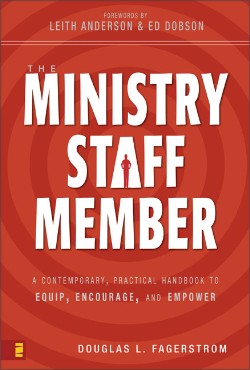
Ministry Staff Member
$19.99This comprehensive resource provides counsel and direction for associate staff members. It can be used to train new staff members, for orientation with seminary interns, for in-service training in church staff meetings, or as a reference tool to consult if facing staff tensions and challenges. Topics covered include knowing your job, embracing your role as a servant leader, serving responsibly, getting along with others, living a balanced life, and avoiding things that get in the way.
Add to cartin stock within 3-5 days of online purchase
-
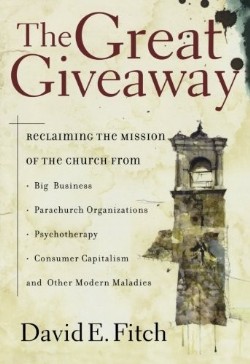
Great Giveaway : Reclaiming The Mission Of The Church (Reprinted)
$27.50Has the North American church relinquished her God-given mission to parachurch organizations, psychotherapy, and consumer capitalism? Warning that postmodern evangelicals are increasingly modeling their ministries after secular sciences and “farming out” church functions in the name of efficiency, Fitch challenges believers to reclaim the lost practices of evangelism, physical healing, and spiritual formation.
Add to cartin stock within 3-5 days of online purchase
-
Leading Leaders : Empowering Church Boards For Ministry Excellence (Reprinted)
$25.00The key to effective leadership in the vast majority of today’s churches lies as much with their governing boards as it does with their pastor. But many churches are lead by those who volunteer to chair committees because there is a need, yet they have no leadership training to speak of. How well-meaning but sometimes ill-prepared lay people guide the path of a church body? The secret lies in offering effective, practical training. Leadership expert Aubrey Malphurs provides this in Leading Leaders. Filling a gaping hole in leadership literature, Malphurs offers workable strategies to train laypeople to successfully lead their churches.
Add to cartin stock within 3-5 days of online purchase
-
Healthy Small Church
$13.99Like Da Vinci’s Vitruvian Man, a healthy church balances the well-being of its individual members with that of the entire church. If a church is afflicted with unhealthy issues, such as feelings of unimportance, a lack of vision, exclusivity, limited resources, or unbalanced leadership, then its health is threatened and it may eventually die. But an unhealthy church can get well and experience vital physical and spiritual growth.
In The Healthy Church, Dennis Bickers diagnoses those things that can threaten the life of your church and prescribes practical remedies for treatment. He emphasizes that maintaining a healthy church means preventing problems from developing by first recognizing their symptoms and then acting accordingly.
Become a healthy church that:
*Has a positive self-image
*Shares a common vision that creates a sense of purpose and unity
*Maintains community while still warmly welcoming new visitors
*Practices the importance of faithful stewardship and financial support
*Understands ministry to be the responsibility of all the members of the church
*Encourages everyone to serve according to his or her spiritual gifts-not by seniority or guilt.Add to cartin stock within 3-5 days of online purchase
-
Evaluating The Church Growth Movement
$26.99“The church growth movement (CGM) has stirred debate ever since it was first introduced by Donald McGavran in the 1960s. By the 1980s it attracted enough attention to merit the publication of around 580 church growth books. Many churches experienced significant growth applying these principles. But during the 1990s critics questioned the movement and its theological underpinnings. Nevertheless, interest in the movement continues in the 21st century. It’s a movement that can’t be ignored. This Counterpoints Church Life book presents five viewpoints on the CGM from national church leaders from a diverse denominational, theological, and geographical representation. The five perspectives include: * Effective evangelism view: Church growth effectively confronts the culture (Elmer Towns) * Gospel in our culture view: Church growth does not effectively engage the culture (Craig Van Gelder) * Centrist view: Church growth has been culturally insightful but theologically superficial (Charles Van Engen) * Reformist view: Church growth has not developed a balanced intertwining of theological reflection, cultural analysis, historical perspective, and practical strategy (Gailyn Van Rheenan) * Renewal view: Church growth must come from the inside out being a community of faith focusing on kingdom issues (Howard Snyder) Not only do the five main contributors respond to each other’s positions, but another chapter gives the responses and views of three nationally known pastors for whom church growth is not an academic discipline but a matter of hands-on daily involvement. The book intends to make a valuable contribution to the church by bringing together conflicting views so all perspectives are heard and readers can make their own informed conclusions. The book’s introduction by Gary McIntosh shows why this is a movement that can’t be ignored. He gives a helpful brief overview of the history of this movement that celebrates its fiftieth anniversary in 2005. Each chapter includes discussion questions enabling readers to use this book in small group and classroom settings.”
Add to cartin stock within 3-5 days of online purchase
-
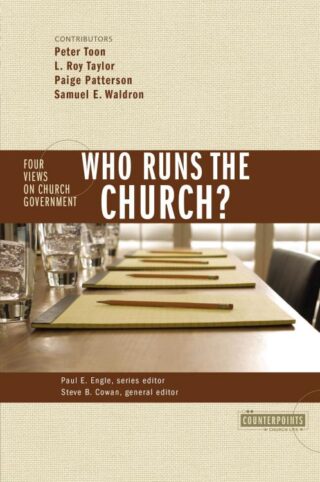
Who Runs The Church
$24.99“Many Protestants, individually and denominationally, are divided by differences regarding the form of church government. While these differences are not necessarily as divisive as theological and doctrinal issues, they are significant to churches and church leaders and affect the way Christians do God’s work. This book in the highly acclaimed Counterpoints series offers insights and contrasts into four kinds of church government: (1) episcopalianism (hierarchical, with priests, bishops, and archbishops), (2) presbyterianism (a representative form at multiple levels-church, classis/presbytery, synod/general assembly), (3) single-elder congregationalism (pastor-led local autonomy), and (4) plural-elder congregationalism (another form of local autonomy). Each form of government is explored through (1) description, (2) historical development, (3) hermeneutical assumptions, (4) biblical and theological foundations, (5) an understanding of the nature, number, and relationship of church officers, (6) the practical implications. The contributors are Peter Toon of the Anglican Church (episcopalianism), L. Roy Taylor of the Presbyterian Church in America (presbyterianism), Paige Patterson of the Southern Baptist Convention (single-elder congregationalism), and Samuel E. Waldron of the Reformed Baptist Church (plural-elder congregationalism).” EDITOR: Cowan, Steven B.
Add to cartin stock within 3-5 days of online purchase